
Contents 10 sections
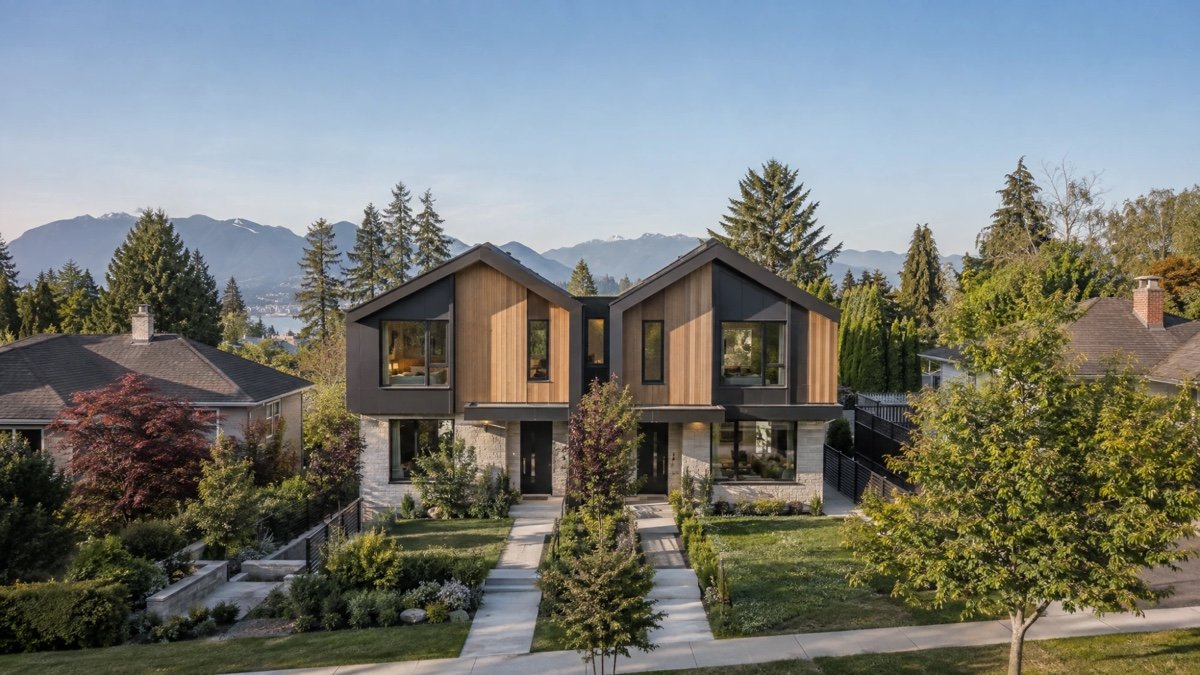
A new half-duplex in Vancouver is worth a median $1,657,000 on the 2026 assessment roll, based on 2,258 halves built since 2017. A whole duplex, both halves, comes to about $3.3 million. East side halves sit around $1.5 to $1.6 million, while Kitsilano, Dunbar and Arbutus Ridge are close to $2.4 million. Values fell about 6% in the year to July 1, 2025.
Key numbers
From T-City’s analysis of City of Vancouver open data, October 2026:
- $1.66M
Median new half-duplex: $1,657,000. The middle half of all new halves fall between $1,498,000 and $1,884,000.
- $3.30M
Median whole duplex: $3,303,000 for both halves.
- $1.50M
Lowest neighbourhood median: Hastings-Sunrise, $1,498,000. Highest: Kitsilano, $2,454,500.
- −6.0%
One-year change: a median 6.0% lower than the year before, for the 1,540 halves on both rolls.
- 67%
Land share: land makes up a median 67% of a new half’s assessed value.
How we built these numbers
We matched every new-duplex permit issued by the City since 2017 to the City’s 2026 property tax data and kept the duplexes that had been completed and split into two strata titles. That gave us 1,129 duplexes, or 2,258 halves. The values are BC Assessment’s, as of July 1, 2025.
Why assessed values rather than sale prices? Because sale prices only exist for the homes that sold, and the best data sits behind the MLS. Assessments cover every new half, sold or not, and anyone can check them. They lag the market by six months or more, so we add the latest market data below.
Values by neighbourhood
The west side commands about $800,000 more per half than the east side. Part of that is land. Part is lot size: west side duplexes are more often on 50 ft lots, so the halves are bigger. If you’re comparing listings, compare within a neighbourhood, not across the city.
On a standard 33 ft east side lot, where each half has about 1,410 sq ft of counted floor area, the east side neighbourhood medians work out to roughly $1,060 to $1,220 per sq ft. Treat that as a rough guide: it assumes every half uses the full floor area.
- City median, $1.66M
- Insured-mortgage cap, $1.50M
T-City analysis of City of Vancouver open data · 2,258 new half-duplexes permitted since 2017, 2026 roll · neighbourhoods with 20+ halves
How values changed
The 1,540 new halves that were on both the 2025 and 2026 rolls dropped a median 6.0%. Taken together, their value fell 5.2%, from $2.82 billion to $2.67 billion.
That’s a slightly steeper drop than the city as a whole. BC Assessment’s typical Vancouver house fell 5%, from $2,205,000 to $2,092,000, and the typical strata home fell 3%, from $798,000 to $772,000. The reason is land. Two thirds of a new half’s value is land, and the median assessed land value of an R1-1 lot fell 5.8% over the same year.
What’s happened since July 2025
The 2026 roll stops at July 1, 2025. Greater Vancouver’s September 2026 numbers fill in what came after:
| Measure, September 2026 | Value | Change from a year earlier |
|---|---|---|
| Townhouse benchmark price | $1,016,700 | down 4.4% |
| Detached benchmark price | $1,784,700 | down 7.3% |
| All home types benchmark | $1,075,900 | down 5.5% |
| Sales, all types | 1,717 | down 8.4%, and 25% below the 10-year September average |
| Active listings | 16,394 | 24.3% above the 10-year September average |
It’s a buyer’s market with plenty of choice, but attached homes are holding up better than detached houses and condos. For a new half-duplex, that points to a softer year, not a collapse.
What moves the price of a half
- Neighbourhood. The biggest factor by far, as the chart shows.
- Lot width. A half on a 50 ft lot gets about 50% more floor area than a half on a 33 ft lot.
- Suites. In our data, duplexes with secondary suites were worth about $220,000 more over the typical house than duplexes without, roughly $110,000 a half.
- Front or back. Less than people assume. The two halves of a stratified duplex were assessed within 5% of each other 79% of the time.
- Finish and timing. A half sold in spring with a finished yard and an occupancy permit in hand sells better than one sold off plans.
Fewer new duplexes are coming
Duplex permits peaked at 375 in 2022 and fell to 237 in 2025. From January 1 to October 2, 2026, the City issued 131, while permits for multiplexes on low-density lots reached 157. Duplexes move from permit to title fairly quickly: about half of those permitted in the first half of 2025 had already been split into two strata titles by October 2026. So the drop in permits shows up as fewer new halves for sale from 2027 on.
T-City analysis of City of Vancouver open data: issued building permits, new buildings, January 2017 to October 2, 2026
Our forecast for the 2027 roll
BC Assessment’s 2027 values will be set as of July 1, 2026. Our forecast, based on the data above:
- New half-duplexes assessed 3% to 6% lower, putting the city median somewhere around $1.56 to $1.61 million. Last year’s drop for the same homes was 6.0%, and attached homes have fallen less than other types this year.
- The east-west gap holds. We expect west side halves to stay about $800,000 above east side halves.
- Prices for new halves hold up better than condos from 2027, as new supply thins out while multiplex units take a while to arrive in volume.
We’ll update this page when the 2027 roll is released in January.
Sources
Every outside figure traces to one of these pages, all opened on October 5, 2026. T-City’s own analysis uses the City of Vancouver open datasets. Rates and fee schedules change, so we recheck them for your lot during feasibility.
- City of Vancouver Open Data: Property tax report (2026 roll, BC Assessment values as of July 1, 2025)
- City of Vancouver Open Data: Issued building permits (1,902 new-duplex permits, 2017 to October 2, 2026)
- BC Assessment: Lower Mainland 2026 property assessments
- Greater Vancouver Realtors September 2026 statistics, summarized by Mike Stewart (released October 2, 2026)